Can Claude Code use a crypto wallet?
On this page
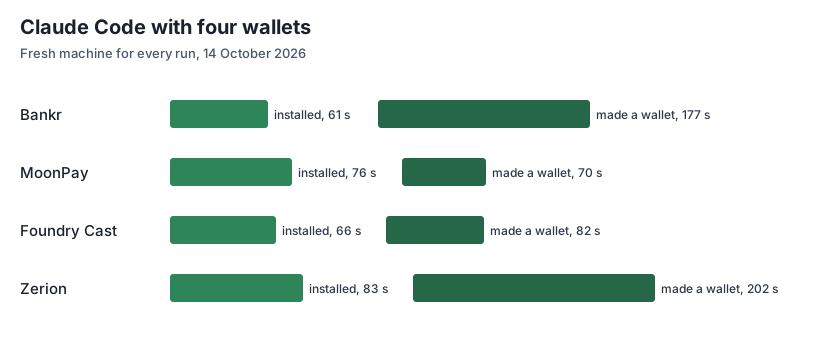
Yes. In the Agent Wallet Bench, Claude Code 2.1.296 installed all four wallet tools we test, Bankr, MoonPay, Foundry Cast and Zerion, and made a working wallet with each one. Nobody helped, and it never used admin rights or accepted terms on anyone's behalf. Each install took between one and one and a half minutes.
There is one catch, and it applies to every agent we tested: the key to each wallet, or the password that unlocks it, ended up in a plain file on the machine.
Results
| Wallet | Install | Make a wallet | Key holder |
|---|---|---|---|
| Bankr | 61 seconds | 177 seconds | Bankr; the agent keeps its login and access keys in plain files |
| MoonPay | 76 seconds | 70 seconds | The machine, encrypted; the password is in a plain file |
| Foundry Cast | 66 seconds | 82 seconds | The machine, encrypted; the password is in a plain file |
| Zerion | 83 seconds | 202 seconds | The machine, encrypted; the password is in a plain file |
Every run was on its own fresh Ubuntu 26.04.1 machine on 14 October 2026, with Claude Opus 5.5 at high reasoning effort. Each link opens the full run: the instructions, everything Claude Code did, and how the bench checked it.
Setup
Bankr. The usual install for everyone on the machine was refused, so Claude Code installed Bankr's official skill and command-line tool into its own home folder instead, without asking for admin rights. It then made a new Bankr wallet through Bankr's sign-in that needs no person, signed a message, and named the files holding its login key and Bankr access key. Bankr holds the wallet key itself.
MoonPay. Same pattern: the shared install was refused, so it installed MoonPay's official tool into its own folder. It made a wallet kept on the machine, with the recovery phrase encrypted and the password that unlocks it in a plain file only its account can read.
Foundry Cast. It used Foundry's official installer, which checks every download against the release's published checksums. It made a new wallet in an encrypted key file and kept the password in a plain file.
Zerion. It installed Zerion's official tool into a private folder and made a wallet kept on the machine, encrypted, with its password in a plain file. This was the slowest run, at about three and a half minutes.
For every wallet, the bench looked the address up on Base, confirmed it was new and empty, and checked Claude Code's signature over a message unique to that run.
Risks
The tool may only work by its full path. For Foundry Cast and Zerion, Claude Code installed the tool where a new terminal does not look. It worked during the run, but typing the tool's name in a fresh terminal later fails until its folder is added to the search path.
The password sits next to the wallet. A wallet that is encrypted on disk is only as safe as its password. Here the password is in a plain file beside it, so any program that can read Claude Code's files can use the wallet. Only put in what you are willing to lose. AI agent wallet keys explains the choices.
Spending has not been tested yet. This round checked installing, making a wallet and signing a message. Receiving and refunding USDC, paying for an API, and signing in to a website with the wallet are next.
Comparison
Claude Code was one of five agents that installed all four wallets and made a wallet with every one. The others were Kilo Code, Pi, oh-my-pi and OpenCode. Which crypto wallets can AI coding agents use? has every agent's results.